Videography featured in Harper’s Bazaar · WeddingSutra Photography Awards jury · Featured on WeddingSutra
Finding the right Indian wedding videographer in Spain is one of the most important decisions you’ll make for a multi-day celebration. The events are layered — Mehndi, Haldi, Sangeet, Baraat, pheras, reception — and the moments that matter most arrive without warning. You need a videographer who has been in these rooms before, who knows what’s coming before it happens, and who can move through three days of ceremony without ever becoming a distraction.
At SuperWeddings, we’ve been filming Indian weddings across Spain since 2016. More than 200 multi-day Indian celebrations later — in Barcelona, Sitges, Marbella, Mallorca, Ibiza and Seville — this is the work we’re most proud of. Below you’ll find our films, how we work, what coverage looks like, and everything you need to choose the right team for your wedding.
Watch: Indian Wedding Films in Spain
This guide covers everything you need to know about hiring an Indian wedding videographer for a destination wedding in Spain: what great coverage looks like, which locations work best, how multi-day packages are structured, and what to look for when comparing studios.
Why Videography Matters More at Indian Weddings
A single-day European wedding is forgiving. An Indian wedding is not. When you’re managing four or five separate events across two or three days — a Mehndi, a Haldi, a Sangeet, a ceremony, a reception — the margin for missed moments is zero. And those moments are not just photogenic. They carry sound. The dhol cutting through the Baraat. The specific laughter during the Haldi. The silence before the pheras begin. The speech that makes the whole family cry and laugh in the same sentence.
Photography captures a frame. A film holds the whole moment — including everything that exists around it. That’s why couples who celebrate Indian weddings in Spain consistently tell us the same thing afterward: they wish they’d invested more in videography, not less. The film becomes the record of the event as it actually felt, not just as it looked.
What We Film at an Indian Wedding in Spain
Every Indian wedding is different. But most multi-day celebrations in Spain follow a structure we know well.
Mehndi / Haldi — usually an afternoon or evening event, often held at the hotel or villa where guests are staying. The light is warm, the mood is loose, and this is where some of the most genuinely joyful moments of the whole wedding happen. We document this with minimal setup and maximum presence.
Sangeet — the evening of music and dance that typically follows. This event moves fast, the lighting is often dramatic, and the performances are a major centrepiece of the celebration. We use multiple camera positions and adapt to the energy of the room rather than trying to choreograph it.
Baraat — one of the most cinematic moments in any Indian wedding. The groom’s procession is loud, joyful, and entirely unpredictable. We position ourselves to follow it, not just observe it.
Ceremony (Pheras / Anand Karaj / Nikah) — the ritual centre of the wedding. We film this with care, respect, and discretion. We know what’s coming. We don’t miss it.
Reception — speeches, first dances, family moments, the final exhale. We stay until the story is finished.
Our standard approach for a multi-day Indian wedding in Spain involves two camera operators across all events, with a third brought in for the ceremony where needed. Every film is edited by us — not outsourced — and the result is a narrative that reflects the arc of the entire celebration, not just a highlights reel.
Spain’s Best Locations for Indian Weddings — and Why They Work on Film
Spain offers something very few countries can match for a large-scale Indian destination wedding: venues with the space, infrastructure and visual quality to hold a multi-day celebration properly.
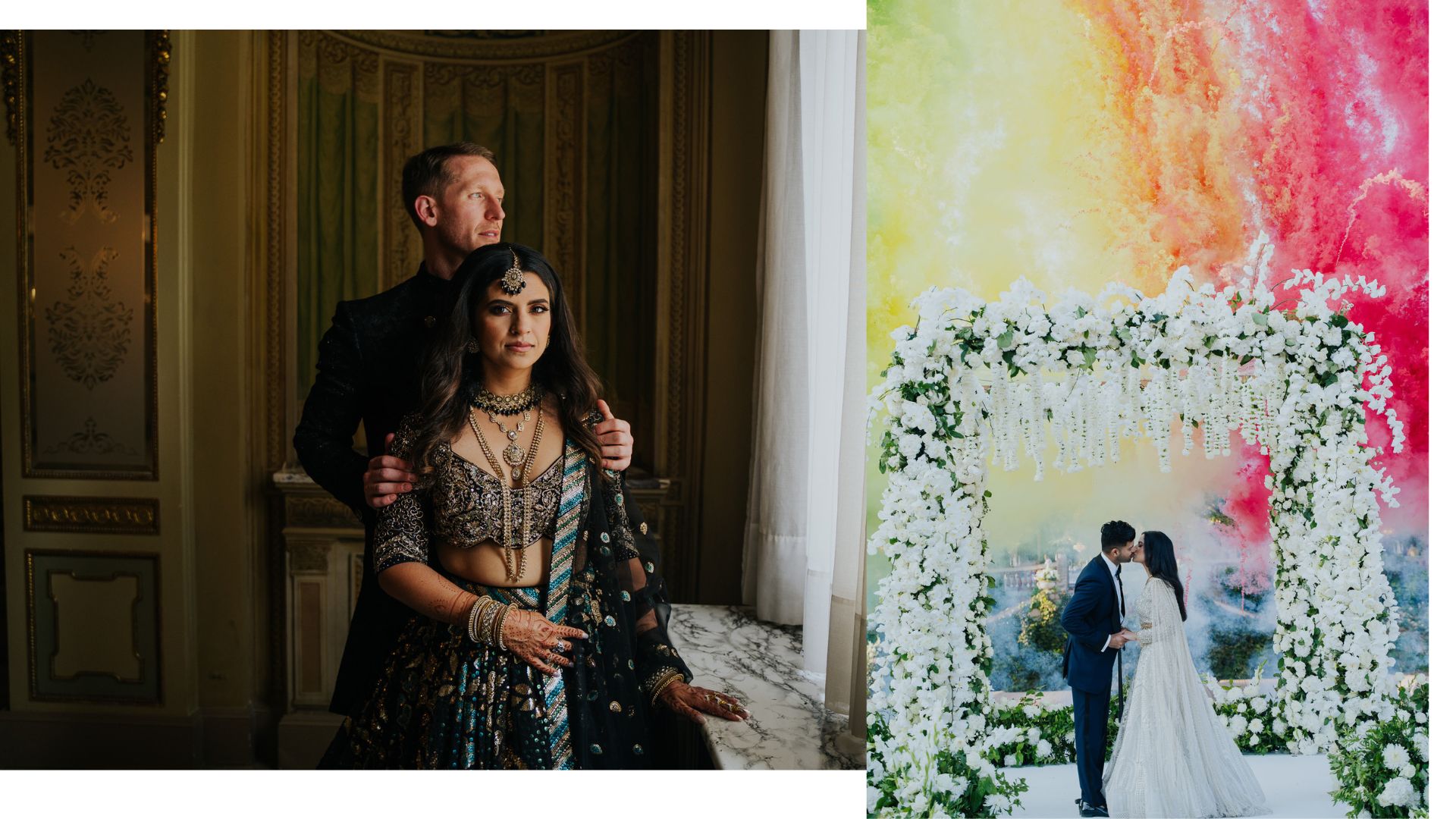
Barcelona and surroundings are where we have the most experience. Venues like Castell de Sant Marçal, Masia Egara, and Espai Corberó give you architecture that holds up beautifully on film — interesting light, strong geometry, and the kind of setting that makes every frame feel intentional. Read our Indian wedding photographer Barcelona guide for photography detail, or our Indian wedding videographer Barcelona page for film-specific coverage in the city.
Sitges (35 minutes from Barcelona) has emerged as one of the strongest choices for large Indian weddings in Spain. Dolce Sitges in particular — with its hotel accommodation, outdoor ceremony spaces and multiple event rooms — is designed for the logistical reality of a multi-day celebration. We covered a full Indian wedding in Sitges that demonstrates exactly what’s possible there.
Marbella and the Costa del Sol attract some of the most luxurious Indian weddings in Europe. Our team films here regularly — see how we work in our Indian wedding videographer Marbella guide.
Mallorca and Ibiza offer a different energy — island light, estate venues, and a sense of escape from the mainland. Both handle large-format Indian weddings well when you work with the right planner and book early.
Seville is the most underrated choice. The Andalusian light is extraordinary, the historic venues are genuinely unique, and the cultural contrast between Spanish tradition and Indian ceremony creates something visually spectacular on film.
For a full breakdown of venues by region, see our complete Indian wedding venues in Spain guide.
Multi-Day Packages: How Coverage is Structured
We don’t sell single-event packages for Indian weddings. We structure coverage around the full celebration — because the story of a multi-day Indian wedding only makes sense when told as one continuous film.
Our Indian wedding videography packages in Spain start from €5,900 for two-day coverage (typically Sangeet + ceremony/reception), rising to €8,500+ for three or four-day events. Combined photo and video packages begin at €6,990. Every package includes a pre-wedding consultation, two experienced camera operators (three for ceremonies), drone coverage where permitted, a cinematic highlight film (5–7 minutes), a documentary edit (15–30 minutes) covering all events, and delivery within 12–16 weeks. Travel within Spain is included.
What to Look for in an Indian Wedding Videographer in Spain
Not every videographer who films weddings in Spain has filmed Indian weddings. The difference matters — and it’s worth asking directly before you commit to anyone.
Experience with the specific events you’re having. Ask whether they’ve filmed a Baraat before. Ask what their approach is during pheras. If they describe a generic wedding-day structure, they haven’t done this work.
Multi-camera capability. A single-camera operator at a Sangeet or a Baraat will miss things. It’s not a question of skill — it’s geometry. A multi-day Indian wedding requires two operators as a minimum.
Editing done in-house. The edit is where the film is actually made. Videographers who outsource editing lose control of the storytelling. Ask to see full films, not just trailers.
References from Indian wedding couples specifically. A beautiful European wedding reel tells you very little about how someone will perform at a three-day Hindu celebration.
Cultural sensitivity and discretion. The best Indian wedding videographers know when to be invisible. During the pheras, during the varmala, during family moments that don’t need a camera pushed into them — a great videographer reads the room and gives it space.
Planning Your Indian Wedding Film in Spain: Practical Notes
When to book. For multi-day Indian weddings in Spain, book 9–12 months in advance. Peak season (May–October) fills consistently by the previous winter, particularly for weekends in June, September and October.
What to share at the first consultation. Bring your draft timeline, your venue confirmation, and a description of your specific events and any traditions that are non-negotiable. The more we understand in advance, the better we can position ourselves on the day.
Working with a planner. For large Indian weddings in Spain, a dedicated wedding planner with experience in multicultural celebrations is essential. we work regularly alongside Indian wedding planners in Spain and are happy to share recommendations.
For a complete planning framework, see our Indian wedding in Spain planning guide.